
October 14, 2025

How Oregon’s Net Metering Program Helps You “Get Paid” for Solar

Author

Adam Walters

Update First Last in Content -> Business Text -> First Last field

Date

October 14, 2025

Share

How Solar NEM Works in Oregon

Going solar in Oregon is one of the most powerful financial and environmental decisions a homeowner can make. Beyond the immediate benefit of producing your own clean energy, a state-level policy called net metering in Oregon fundamentally transforms your relationship with the electric grid, turning your home into a mini power station that can actually earn you credit.

While it sounds technical, the concept is simple: you get full, one-to-one credit for the extra solar power you produce and send to the grid. As Oregon City’s #1 solar installer with over 1050 projects completed, we’ve seen firsthand how this program helps hundreds of homeowners slash their electricity bills and achieve the fastest possible payback on their investment.

This comprehensive guide will walk you through exactly how it works, what to expect on your bill, and how to maximize your financial returns.

What is Net Metering, Really? An In-Depth Look

At its core, net metering is a billing arrangement that credits solar energy system owners for the electricity they add to the electrical grid. Think of the grid as a massive, shared energy bank. On a sunny Oregon afternoon, your high-efficiency REC solar panels might be producing far more power than your home is using. Instead of letting that valuable energy go to waste, it flows out through your meter and into the grid, supplying clean power to your neighbors.

Your utility company installs a special “bi-directional” meter that tracks this two-way flow: power you draw from the grid and power you send to the grid. For every kilowatt-hour (kWh) of power you export, you receive a kWh credit on your account. Later, when your panels aren’t producing—at night or on a cloudy winter day—you draw power from the grid as you normally would. But instead of paying the full retail rate for that electricity, you first draw from your bank of accumulated credits.

This critical one-to-one credit is what makes Oregon’s program so valuable. You are credited at the full retail rate for the power you export, the same rate you would have paid for it. This policy, supported by the Oregon Public Utility Commission (PUC) , ensures you receive maximum value for your solar investment.

How Does Net Metering Work in Oregon, Step-by-Step?

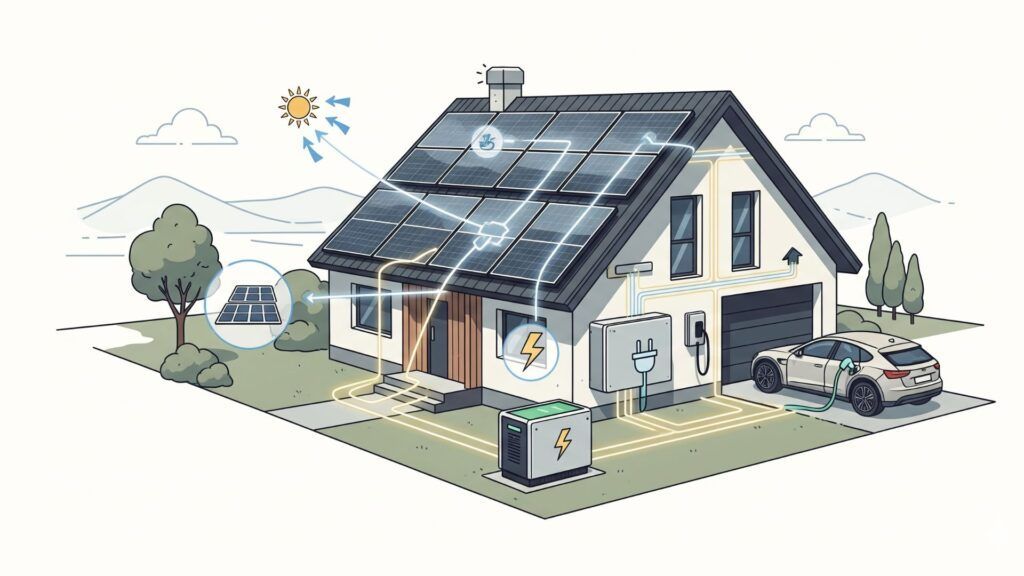
House with solar panels, charging an electric car and powering a battery; diagram illustrating energy flow.

The entire process is automated and seamless. Once your system is installed and approved by the utility, the magic happens behind the scenes every single day.

  1. Peak Sun, Peak Production: During the day (roughly 9 AM to 5 PM), your panels are at their peak. They convert sunlight into direct current (DC) electricity, which is then converted by an Enphase microinverter into alternating current (AC) that your home can use. This clean energy powers your lights, appliances, and electronics first.
  2. Exporting Your Surplus: If you’re at work and the house is empty, your energy production will likely exceed your consumption. This surplus power is automatically exported to the grid.
  3. Earning Your Credits: Whether you have PGE net metering or Pacific Power net metering , your bi-directional meter precisely records every exported kWh. Your utility account is credited for this amount. This is how you effectively sell power back to the grid in Oregon .
  4. Using Credits at Night: As the sun sets, your panels stop producing. Your home begins drawing electricity from the grid. However, your utility will apply your banked credits to offset this usage before charging you for any new consumption.

This daily cycle allows you to leverage the long, sunny days of summer to build up a large bank of credits that can significantly reduce, or even eliminate, your electricity bills during the darker, rainier months.

A Practical Example: The Annual Cycle

Let’s imagine a typical family in Clatsop County:

  • In July: Their system produces 1,100 kWh of energy. They only use 700 kWh during the day, so they export a surplus of 400 kWh to the grid, “banking” it for later. Their bill is likely just the small monthly base connection fee.
  • In November: The shorter, cloudier days mean their system only produces 350 kWh. Their home, however, uses 800 kWh. Instead of paying for the 450 kWh difference, they automatically draw from the 400 kWh surplus they banked in July. They only have to pay for the remaining 50 kWh.

At the end of a 12-month period, your utility does an annual “true-up.” If you have any credits left over, the policy varies. For most residential customers of PGE and Pacific Power , these excess credits are granted to the utility without payment. This is why expert system design is crucial—we size your system to meet your annual needs precisely, ensuring you don’t leave significant value on the table.

Pairing Net Metering with Battery Storage

While net metering is a fantastic incentive, what about power outages? And what if you want to be even more energy independent? This is where adding a home battery backup system , like an Enphase IQ Battery, creates the ultimate energy solution.

  • Energy Resilience: During a grid outage, a solar-only system will shut down for safety. A battery, however, allows you to use your stored solar energy to keep critical circuits running for hours or even days.
  • Maximize Self-Consumption: With a battery, you can store your excess solar power instead of sending it all to the grid. Then, at night, you can use your own stored energy first before drawing from the grid. This gives you ultimate control over your power.
  • Protection from Policy Changes: While Oregon’s net metering program is strong, policies can change. Owning a battery ensures you can always store and use your own energy, making you less dependent on utility programs.

Black solar panels on a house roof with a garage and electric car charging.

Maximize Your Savings with Energy Solutions

Understanding the nuances of Oregon solar incentives is key to achieving the fastest payback. Net metering is the cornerstone, but maximizing its potential requires a professional, experienced partner.

At Energy Solutions, we are more than installers—we are your local energy consultants. We handle every single step of the process with a transparent, “no surprises” approach:

  • Expert System Design: We analyze your energy usage to design a system that maximizes your net metering credits without significant overproduction.
  • Full-Service Interconnection: We manage all the complex paperwork and applications with PGE or Pacific Power to get your system approved and enrolled in the net metering program.
  • Quality Solar Installation : Our experienced, local electricians install top-tier equipment from brands like REC and Enphase to ensure your system performs flawlessly for decades.

Are you ready to see how you can leverage Oregon’s net metering program to turn your roof into a power-generating asset and watch your electricity bills shrink?

Schedule your free, no-obligation consultation today! Call us at 503-680-3718 or fill out our online form to get a detailed, transparent quote.

By Adam Walters December 30, 2025
Stop paying at the pump and the plug. Learn how to fuel your electric vehicle with solar energy, how many panels you need, and why it’s the ultimate "Oregon" upgrade.
By Adam Walters December 22, 2025
Living in the PNW means battling moss, pollen, and pine needles. Learn the right way to clean your solar panels (and what to avoid) to keep your energy production high.
By Adam Walters December 19, 2025
Confused by building codes and electrical permits? We break down the solar permitting process in the Portland Metro area, from engineering review to the final PGE inspection.
By Adam Walters December 16, 2025
Deciding how to pay for solar? We compare solar loans vs. cash, breaking down the benefits of each option from ROI to zero-down financing for Oregon homeowners.
By Adam Walters December 10, 2025
Analyze the financial returns of commercial solar in the Portland Metro area. Learn about the 2025 incentives, 5-year MACRS depreciation, and typical ROI for Oregon businesses.
By Adam Walters December 5, 2025
Thinking of installing solar panels yourself? We break down the true costs, safety risks, permit hurdles, and warranty issues associated with DIY solar in the Oregon City area.

Solar panels on a dark roof under a blue sky.
By Adam Walters November 23, 2025
Discover the #1 reason to hire a NABCEP certified solar installer. Learn how this gold-standard certification ensures quality, safety, and a faster ROI for your home.

Person points at solar panel layout on laptop, with another person looking on.
By Adam Walters November 19, 2025
Before hiring an Oregon solar installer, use our guide to verify their license with the CCB tool. Learn why NABCEP certification matters for your home's safety & ROI.
Solar panel: black front, white back with junction box and wires, stacked panels on gray background.
By Adam Walters October 7, 2025
Choosing a solar inverter? Compare microinverters vs. string inverters on cost, performance, and shade tolerance. Find the best option for your home solar system.