December 16, 2025

Solar Financing in Oregon: Cash Purchase vs. Solar Loans Explained

Author

Adam Walters

Update First Last in Content -> Business Text -> First Last field

Date

December 16, 2025

Share

Key Highlights

  • Cash is King for ROI: Paying cash yields the highest long-term savings because you avoid interest and financing fees completely.
  • Loans Offer Immediate Cash Flow: With $0 down solar loans, you can often swap your current electric bill for a loan payment that is roughly the same (or lower).
  • Watch for “Dealer Fees”: National solar lenders often offer “low rates” like 3.99% but tack on a 25% fee to the project cost. We explain why local banks are often better.
  • The Tax Credit Applies to Both: You get the 30% Federal Tax Credit regardless of whether you pay cash or finance.
  • Local Lenders: Oregon credit unions (like OnPoint, Unitus, or SELCO) often have specialized “Green Loans” with transparent terms.

Paying for Solar: A Guide to Loans vs. Paying Cash

At Energy Solutions , we know that deciding to go solar is two decisions in one. First, the technical decision: Do I want panels on my roof? Second, the financial decision: How am I going to pay for them?

We are consultants, not financial advisors, but having helped hundreds of Oregon City families navigate this purchase, we know the landscape well. There is no “right” answer, but there is definitely a right answer for your specific budget.

Here is an honest look at the two main paths: Paying Cash vs. Financing.

Option 1: The Cash Purchase (The “ROI King”)

If you have the capital available—whether in savings or a HELOC ( Home Equity Line of Credit )—paying cash is strictly the best financial move.

Why?

  1. Lowest Total Cost: You pay for the equipment and the labor. That’s it. No interest, no origination fees, no bank closing costs.
  2. Instant Equity: You own the system from Day 1. When you sell your home, there is no lien to pay off; just a value-adding asset on your roof.
  3. Fastest Payback: In Oregon, a cash system typically “pays for itself” in energy savings in about 9 to 12 years. After that, every kilowatt-hour you generate is 100% free profit.

Who is this for? Homeowners who want to maximize their total lifetime savings and treat solar as a high-yield investment vehicle.

Option 2: The Solar Loan (The “Bill Swap”)

For many families, dropping $20,000+ in cash isn’t feasible or preferred. That is where solar financing comes in.

The goal here isn’t necessarily “lowest total cost,” but rather “cash flow neutrality.” Essentially, you are taking the money you already pay PGE every month (which rents your power) and shifting it to a loan payment (which buys your power).

The Pros:

  • $0 Down: Most solar loans require no money upfront.
  • Fixed Payments: Utility rates rise every year (PGE has hiked rates significantly recently). Your loan payment stays flat for the 10, 15, or 20-year term.
  • Ownership: Unlike a lease (which we rarely recommend), with a loan, you still own the system and claim the tax incentives.

Who is this for? Homeowners who want to go green and lock in their energy costs without depleting their savings account.

The “Dealer Fee” Warning (Read This!)

This is where the “Neighborly Expert” advice is crucial.

If you get a quote from a national door-knocking solar company, you might see a loan with a shockingly low interest rate (like 3.99%). In today’s economy, that sounds too good to be true. It is.

To get that rate, the lender charges a “Dealer Fee” (or origination fee) that can add 20% to 30% to the cash price of your system. You end up paying much more for the panels just to make the monthly payment look lower.

The Oregon Advantage: Local Credit Unions In the Pacific Northwest, we are lucky to have incredible credit unions (like Puget Sound Cooperative Credit Union , OnPoint , or Unitus ) that offer “Green Energy Loans.”

  • The Rates: Usually slightly higher than the “teaser rates” (e.g., 7-9%).
  • The Benefit: ZERO dealer fees. The price of the system is the cash price.
  • Our Advice: We almost always recommend local credit union financing over national solar loans. It is transparent, honest, and usually cheaper in the long run.

How the Tax Credit (ITC) Fits In

Regardless of how you pay, the 30% Federal Investment Tax Credit (ITC) is yours.

  • Cash Buyers: You claim the credit on your next tax return and keep the cash.
  • Loan Buyers: Most lenders structure the loan expecting you to pay that 30% into the loan within 18 months. This is called a “re-amortization.” If you pay the tax credit into the loan, your monthly payment stays low. If you keep the cash, your monthly payment might go up.

The Bottom Line

There is no bad way to pay for energy independence, as long as you understand the terms.

  • Pay Cash if you want the best Return on Investment.
  • Finance if you want to keep your cash reserves intact and simply swap a utility bill for a solar payment.

Whatever you choose, Energy Solutions provides a clear, line-item proposal showing the cash price vs. the financed price side-by-side. No hidden fees, no math tricks.

Want to see the numbers for your home? Get My Free Quote or call our local team at 503-680-3718 .

Frequently Asked Questions

Do you offer leases or PPAs (Power Purchase Agreements)?

Generally, no. In Oregon, owning your system (via cash or loan) yields far better financial returns than leasing. Leases often complicate home sales and give the tax benefits to the leasing company, not you.

Can I use a HELOC to pay for solar?

Absolutely. Many of our customers use a Home Equity Line of Credit. The interest may be tax-deductible (ask your CPA), and you avoid the specific constraints of a solar-only loan.

What happens to the loan if I move?

You have two options: pay it off using the proceeds from the home sale (since solar increases home value), or in some cases, transfer the loan to the new buyer (though paying it off is usually cleaner/easier).

By Adam Walters December 30, 2025
Stop paying at the pump and the plug. Learn how to fuel your electric vehicle with solar energy, how many panels you need, and why it’s the ultimate "Oregon" upgrade.
By Adam Walters December 22, 2025
Living in the PNW means battling moss, pollen, and pine needles. Learn the right way to clean your solar panels (and what to avoid) to keep your energy production high.
By Adam Walters December 19, 2025
Confused by building codes and electrical permits? We break down the solar permitting process in the Portland Metro area, from engineering review to the final PGE inspection.
By Adam Walters December 10, 2025
Analyze the financial returns of commercial solar in the Portland Metro area. Learn about the 2025 incentives, 5-year MACRS depreciation, and typical ROI for Oregon businesses.
By Adam Walters December 5, 2025
Thinking of installing solar panels yourself? We break down the true costs, safety risks, permit hurdles, and warranty issues associated with DIY solar in the Oregon City area.
Solar panels on a dark roof under a blue sky.
By Adam Walters November 23, 2025
Discover the #1 reason to hire a NABCEP certified solar installer. Learn how this gold-standard certification ensures quality, safety, and a faster ROI for your home.

Person points at solar panel layout on laptop, with another person looking on.
By Adam Walters November 19, 2025
Before hiring an Oregon solar installer, use our guide to verify their license with the CCB tool. Learn why NABCEP certification matters for your home's safety & ROI.
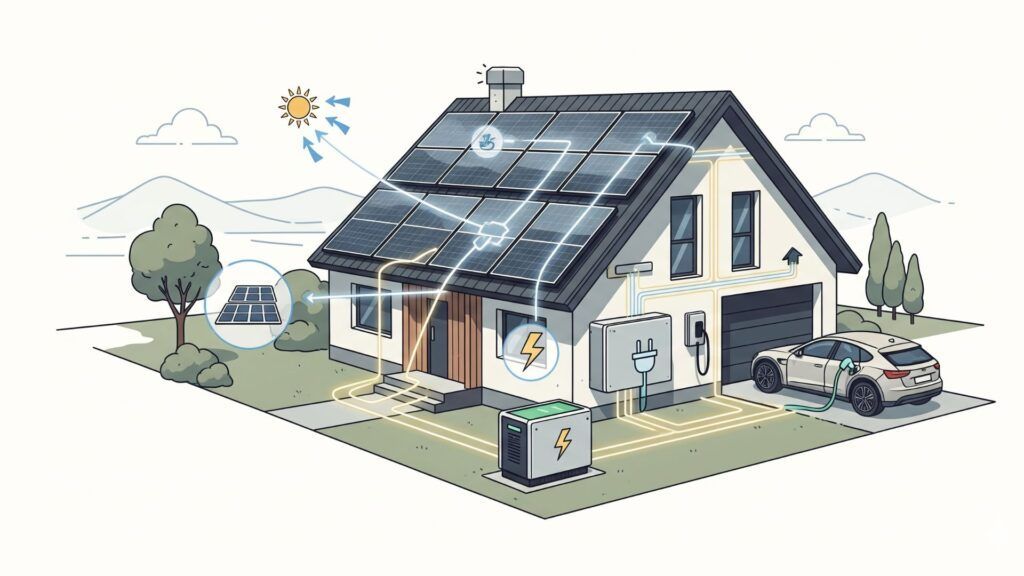
House with solar panels, electric car, battery storage, and an illustration showing the flow of solar energy.
By Adam Walters October 14, 2025
How Solar NEM Works in Oregon Going solar in Oregon is one of the most powerful financial and environmental decisions a homeowner can make. Beyond the immediate benefit of producing your own clean energy, a state-level policy called net metering in Oregon fundamentally transforms your relationship with the electric grid, turning your home into a mini power station that can actually earn you credit. While it sounds technical, the concept[…]
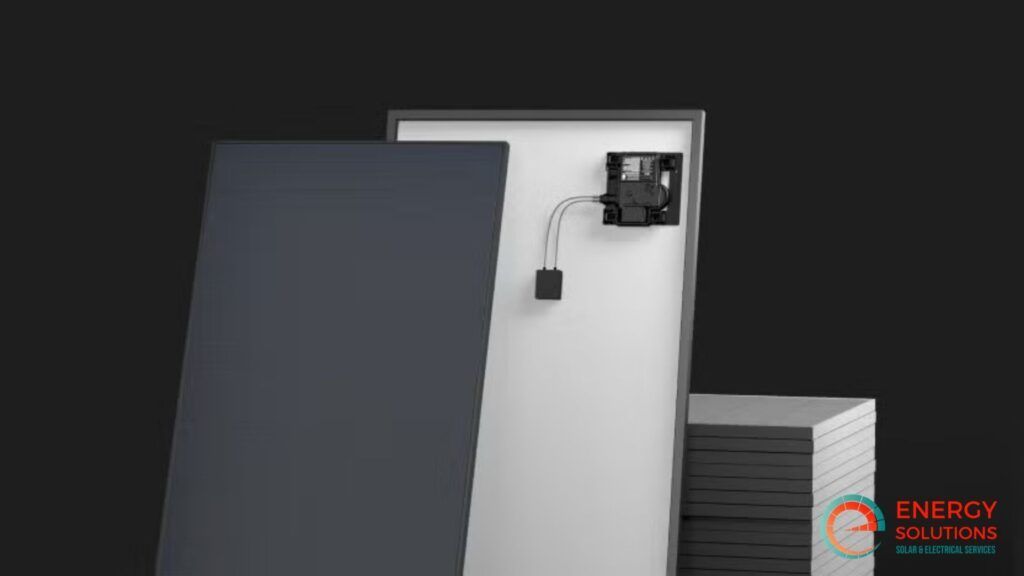
Solar panel: black front, white back with junction box and wires, stacked panels on gray background.
By Adam Walters October 7, 2025
Choosing a solar inverter? Compare microinverters vs. string inverters on cost, performance, and shade tolerance. Find the best option for your home solar system.