December 10, 2025

What is the ROI for Commercial Solar in Oregon? A 2025 Analysis

Author

Adam Walters

Update First Last in Content -> Business Text -> First Last field

Date

December 10, 2025

Share

Key Highlights

  • Strong Investment: Commercial solar in Oregon provides an excellent return due to high utility rates and strong state/federal incentives.
  • Rapid Depreciation: The Modified Accelerated Cost Recovery System (MACRS) allows businesses to deduct a large portion of the system cost quickly.
  • Payback Window: Typical payback periods for commercial systems often range from 3 to 7 years , depending heavily on facility type and power consumption.
  • Incentive Stack: Businesses can stack the 30% Federal Investment Tax Credit (ITC) with MACRS and local Energy Trust of Oregon cash rebates.
  • Budget Certainty: It provides immediate protection against unpredictable PGE rate hikes, converting variable operating expenses into fixed capital assets.

What is the ROI for Commercial Solar in Oregon? A 2025 Analysis

For small business owners and commercial property managers in Oregon City and the wider Portland Metro area, electricity bills are not just a nuisance—they are a significant, constantly rising operating expense.

When a national solar company pitches you commercial solar, they focus on the “green marketing.” At Energy Solutions , we focus on your bottom line. Commercial solar is not a marketing tool; it’s a high-yield, long-term capital investment that drastically lowers overhead.

As your NABCEP Certified local energy consultants, we’ve analyzed the financials for warehouses, small offices, agricultural operations, and retail centers. Here is our 2025 breakdown of the ROI (Return on Investment) for commercial solar in Oregon.

The Three Pillars of Commercial ROI

The Return on Investment for a business is calculated differently than for a residential homeowner. It’s driven by three powerful financial mechanisms:

Pillar 1: The Energy Offset (Operating Expense Reduction)

This is the most straightforward return. Every kilowatt-hour (kWh) your commercial solar system produces is a kWh you do not have to purchase from PGE or other local utilities.

  • Commercial Rates are High: Commercial and industrial customers often pay higher rates and face complex “demand charges” that penalize peak usage. Solar immediately wipes out a significant portion of this high-cost power.
  • Net Metering: Like residential systems, commercial systems benefit from Net Metering, earning credits for excess power sent back to the grid.

Pillar 2: The Federal Investment Tax Credit (ITC)

This is a massive, immediate financial boost. Businesses can claim 30% of the total system cost as a direct credit against their federal tax liability. This credit significantly reduces the upfront cost of the system.

Pillar 3: Accelerated Depreciation (MACRS)

This is the single greatest financial driver for commercial solar. The Modified Accelerated Cost Recovery System (MACRS) allows businesses to recover the cost of a tangible capital asset (like a solar array) over a shorter time period than its actual useful life.

  • The Benefit: Solar is classified in the 5-year MACRS schedule. This means you can typically deduct approximately 85% of the system’s cost from your taxable income within the first six years. This deduction translates directly into significant tax savings, often in the first two years of operation.

Calculating the Payback Period

When combining energy savings and tax deductions, the payback period for commercial solar is usually much faster than residential.

Example Scenario (Typical Oregon City Office Building)

Metric Value Notes
System Size 100 kW Covers substantial electricity usage.
Total Cash Cost $250,000 Pre-incentive cost.
Year 1 Energy Savings $20,000 Reduction in annual utility spend.
Federal ITC (30%) -$75,000 Immediate reduction of tax liability.
MACRS Deduction Value ~$48,000 Total value of accelerated tax deductions.
Net Cost (After Tax Benefits) $127,000 True capital outlay after incentives.
Payback Period ~6.35 Years ($127,000 Net Cost / $20,000 Annual Savings)

Depending on your business’s tax liability and power use profile, we regularly see payback periods ranging from 3 years (for high-consumption businesses taking maximum advantage of depreciation) to 7 years (for low-consumption facilities).

The Advantage of Local Incentives (Energy Trust of Oregon)

In addition to the strong federal incentives, commercial customers in the Portland area often qualify for cash rebates through the Energy Trust of Oregon (ETO) .

  • Cash Rebates: ETO frequently offers direct cash incentives per watt installed, further driving down the initial capital expenditure.
  • Certified Partner: As an Energy Trust of Oregon partner, we ensure your project is designed and installed according to their rigorous standards, maximizing your rebate eligibility.

It is essential to work with a local installer who knows how to “stack” these incentives correctly, ensuring you don’t leave any money on the table.

Financing Commercial Solar

Most businesses treat solar as a capital expenditure, utilizing commercial loans, leases, or specialized Property Assessed Clean Energy (PACE) financing.

  • Commercial Loans: Term loans, often structured to match the useful life of the asset, are the most common approach. We can connect you with local Oregon banks and credit unions familiar with green energy projects.
  • Solar Leases: While generally poor for residential use, commercial solar leases can sometimes be advantageous for non-profit entities or businesses with low immediate tax liability, allowing them to benefit from the tax deductions passed through to the lessor.

Beyond the Dollar Sign (Non-Financial ROI)

While the financial return is the primary driver, commercial solar offers secondary returns that are increasingly valuable to Oregon businesses:

  1. Hedge Against Rate Hikes: You buy certainty. Your energy source is fixed, protecting your operating costs from PGE’s unpredictable rate increases for the next 25+ years.
  2. Corporate Image: In the eco-conscious Pacific Northwest, demonstrating commitment to sustainability is a competitive advantage that appeals to customers and top talent.
  3. Future-Proofing: Commercial solar installations are easily paired with Generac or industrial-grade battery storage, providing critical backup power to keep servers, vital machinery, and essential systems running during grid failures.

The Bottom Line: An Investment You Can Trust

Commercial solar is no longer a niche technology; it is a smart, proven financial strategy that immediately benefits your balance sheet. The combination of massive federal tax incentives, accelerated depreciation, and operational savings makes the payback period rapid and the total return immense.

As Oregon City’s leading commercial energy consultants, we don’t just install panels; we design financial solutions. We handle the complex permitting (structural, electrical, and PGE interconnection), the engineering, and all the tax paperwork necessary to ensure you maximize your ROI.

Ready to turn your roof into a profit center? Get My Free Quote or call our local team at 503-680-3718 to schedule a comprehensive commercial site assessment and financial analysis.

By Adam Walters December 30, 2025
Stop paying at the pump and the plug. Learn how to fuel your electric vehicle with solar energy, how many panels you need, and why it’s the ultimate "Oregon" upgrade.
By Adam Walters December 22, 2025
Living in the PNW means battling moss, pollen, and pine needles. Learn the right way to clean your solar panels (and what to avoid) to keep your energy production high.
By Adam Walters December 19, 2025
Confused by building codes and electrical permits? We break down the solar permitting process in the Portland Metro area, from engineering review to the final PGE inspection.
By Adam Walters December 16, 2025
Deciding how to pay for solar? We compare solar loans vs. cash, breaking down the benefits of each option from ROI to zero-down financing for Oregon homeowners.
By Adam Walters December 5, 2025
Thinking of installing solar panels yourself? We break down the true costs, safety risks, permit hurdles, and warranty issues associated with DIY solar in the Oregon City area.
Solar panels on a dark roof under a blue sky.
By Adam Walters November 23, 2025
Discover the #1 reason to hire a NABCEP certified solar installer. Learn how this gold-standard certification ensures quality, safety, and a faster ROI for your home.

Person points at solar panel layout on laptop, with another person looking on.
By Adam Walters November 19, 2025
Before hiring an Oregon solar installer, use our guide to verify their license with the CCB tool. Learn why NABCEP certification matters for your home's safety & ROI.
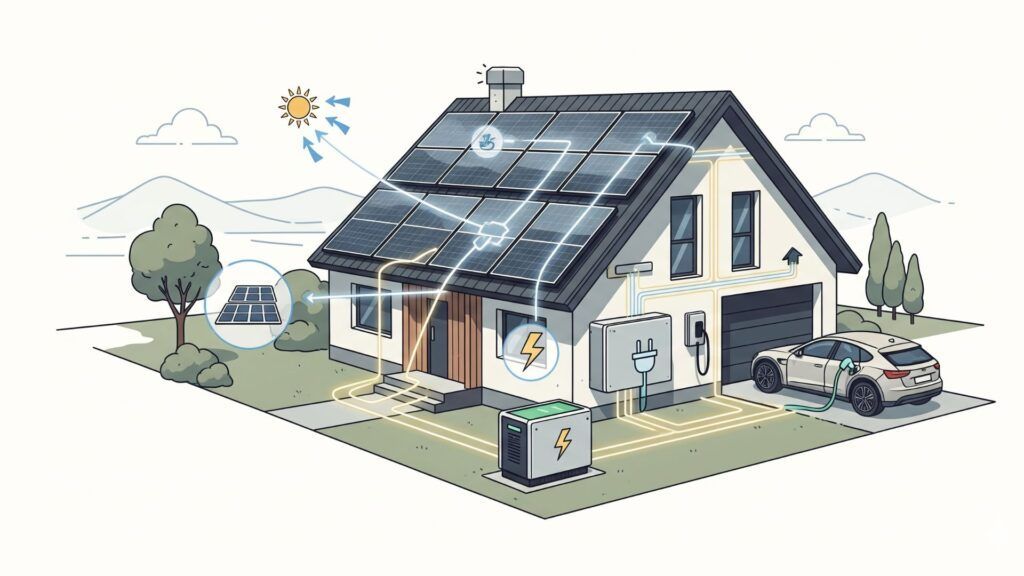
House with solar panels, electric car, battery storage, and an illustration showing the flow of solar energy.
By Adam Walters October 14, 2025
How Solar NEM Works in Oregon Going solar in Oregon is one of the most powerful financial and environmental decisions a homeowner can make. Beyond the immediate benefit of producing your own clean energy, a state-level policy called net metering in Oregon fundamentally transforms your relationship with the electric grid, turning your home into a mini power station that can actually earn you credit. While it sounds technical, the concept[…]
Solar panel: black front, white back with junction box and wires, stacked panels on gray background.
By Adam Walters October 7, 2025
Choosing a solar inverter? Compare microinverters vs. string inverters on cost, performance, and shade tolerance. Find the best option for your home solar system.